
The Starling, Shakespeare, and an Invasion
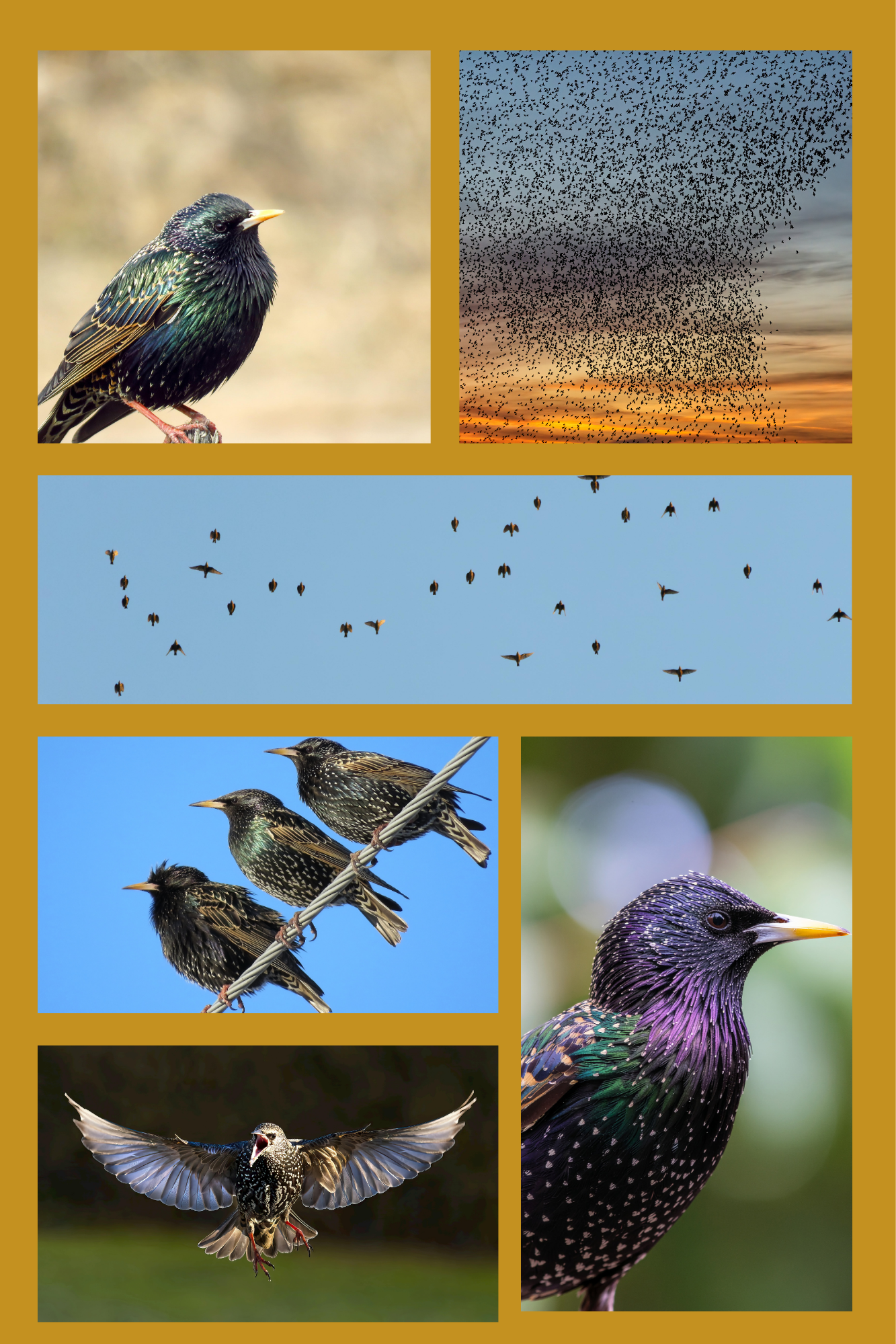
On an autumn afternoon in Ohio, you don’t have to look far to find European starlings. They gather by the hundreds in farm fields, crowd onto power lines and descend on lawns looking for insects. At first glance they appear black, but in good light their feathers are glossy green and purple, speckled with white.
European starlings (Sturnus vulgaris) are native to Europe and parts of Asia and North Africa. They were introduced to North America in the nineteenth century and have since spread across nearly the entire continent. Here in Ohio, they have adapted particularly well to the mix of farmland, towns and suburban development.
There is also a peculiar bit of literary history attached to how they got here.
A Bird in Shakespeare
Shakespeare mentions a starling in Henry IV, Part 1. Hotspur, angry that King Henry has forbidden him from speaking the name Mortimer, says he will teach a starling to say “Mortimer” and give it to the king to annoy him.
Anyone who has spent much time around starlings can appreciate the joke. They are excellent mimics, capable of copying the calls of other birds as well as whistles, mechanical noises and even bits of human speech.
Almost three hundred years after Shakespeare wrote the play, a New York pharmacist named Eugene Schieffelin was involved in releasing European starlings in New York City. About 100 birds were released in Central Park in 1890 and 1891. Those early introductions eventually took hold, and starlings began spreading outward.
This is also where Shakespeare reenters the story.
For years, the commonly repeated version was that Schieffelin wanted to introduce every bird mentioned in Shakespeare’s works to America. Shakespeare had mentioned a starling, so Schieffelin supposedly brought starlings to Central Park.
It makes for a memorable story, but there is a problem with it: historians haven’t found good evidence that this was actually his reason.
How Shakespeare Got the Blame
Schieffelin was involved with the American Acclimatization Society, one of several nineteenth-century organizations interested in introducing foreign plants and animals to the United States. At the time, moving familiar European species into American landscapes was often seen very differently than it is today. The ecological consequences of introducing a nonnative species were not well understood.
What researchers have not found is contemporary evidence showing that Schieffelin had a plan to introduce all of Shakespeare’s birds. Even accounts of his life and his bird introductions do not mention such a project. The Shakespeare explanation seems to have appeared later and then been repeated often enough to become part of the accepted story.
There is still a Shakespeare connection, just not quite the one we have been telling. Shakespeare really did write about starlings, and Schieffelin really was involved in introducing them to New York. We just can’t confidently say that one caused the other.
From Central Park to Ohio
European starlings proved remarkably well suited to life in North America. They eat a wide range of foods, tolerate living close to people and readily use farms, lawns, cities and disturbed habitats. Today they are found throughout Ohio and across most of the continent.
Their nesting habits are one reason they are considered invasive. Starlings are cavity nesters, using holes in trees and other sheltered spaces to raise their young. Those sites are also needed by native birds such as bluebirds, woodpeckers and some swallows, and starlings can compete aggressively for them. Large flocks can also cause problems on farms and around urban roosts.
As with most ecological problems, though, the picture is more complicated than simply blaming one bird. Native bird populations are also dealing with habitat loss, pesticides, pollution, climate change and many other changes to the landscape. Starlings are one piece of a much larger story about the ways human activity has reshaped North American ecosystems.
And humans are the reason the starlings are here in the first place. They didn’t find their own way across the Atlantic; we brought them.
Living With the Starling
Calling the European starling invasive doesn’t require us to pretend there is nothing interesting about it. They are intelligent, highly social birds. Their dark feathers are surprisingly colorful up close, and their ability to imitate other sounds is remarkable. When thousands gather together, their synchronized flocks—called murmurations—can be extraordinary to watch.
They are also a good example of why we are much more cautious about moving species around today. A relatively small number of birds introduced more than a century ago became established in an ecosystem that had evolved without them, and there was no practical way to undo that introduction once they began to spread.
Perhaps the Shakespeare story has lasted because it makes such a neat explanation for a messy piece of environmental history. The real story is less romantic, but more useful. Starlings are here because people once believed introducing species from other parts of the world was a good idea. Today, seeing them gathered in an Ohio field is a small reminder that decisions about the natural world can have consequences that last far beyond the people who made them.
Sources & Further Reading
U.S. Department of Agriculture, APHIS Wildlife Services. European Starlings: Wildlife Damage Management Technical Series. A strong primary source for the starling’s status as an introduced/invasive species, biology, adaptability, agricultural impacts, and management in the United States. USDA APHIS
USDA European Starling Technical SeriesCornell Lab of Ornithology. European Starling — All About Birds. Useful for identification, habitat, nesting behavior, flocking/murmuration behavior, and the history of introductions in North America. Cornell importantly notes that starlings were introduced at several North American locations—including Ohio—before the better-known Central Park introductions. All About Birds
Cornell Lab: European StarlingFugate, Lauren, and John MacNeill Miller. “Shakespeare’s Starlings: Literary History and the Fictions of Invasiveness.” Environmental Humanities, vol. 13, no. 2, 2021, pp. 301–322. This is the most important source for your Shakespeare section. The authors investigated the historical record and found that the familiar claim that Eugene Schieffelin released starlings as part of a mission to introduce every bird mentioned by Shakespeare is not supported by contemporary evidence. Allegheny College DSpace Repository
Read the research paperFolger Shakespeare Library. “Birds of Shakespeare: The Common Starling.” An accessible discussion of both Shakespeare’s starling reference and the later Schieffelin legend, drawing heavily on the Fugate and Miller research. Folger Shakespeare Library
Folger: Birds of Shakespeare — The Common StarlingShakespeare, William. Henry IV, Part 1, Act 1, Scene 3. Folger Shakespeare Library. This is the primary literary source. Hotspur proposes teaching a starling to repeat “Mortimer” in order to continually irritate King Henry—evidence that the starling's ability to mimic speech was already familiar enough in Shakespeare's time for the joke to work. Folger Shakespeare Library
Read Henry IV, Part 1, Act 1, Scene 3 at Folger